

PREFACE
What happens when we begin believing the stories we tell ourselves about aging?
~
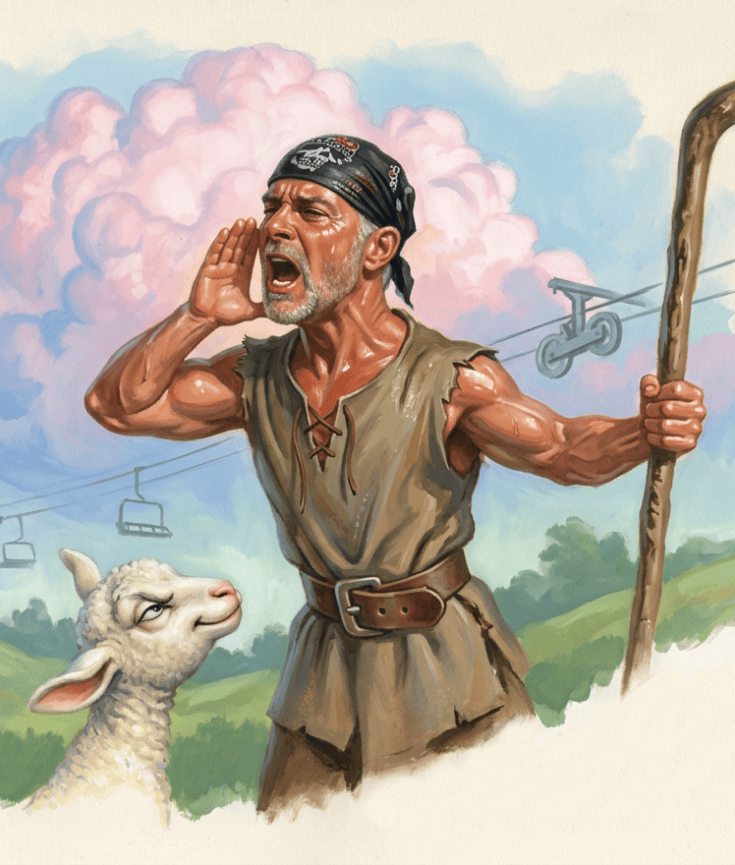
The Boy Who Cried Wolf
is a 2,500-year-old fable about credibility.
When you repeatedly lie, people eventually stop believing you, even when you finally tell the truth. It’s a reminder that trust is easy to destroy and difficult to rebuild. With others. And with ourselves.
But this version isn’t about a young lad who cried wolf too many times in a small village.
It’s about what happens when we repeatedly announce our own decline to the world.
What happens when we keep telling ourselves we’re old until we begin to believe that the things we once did are no longer possible?
What happens when we surrender something to aging that we didn’t actually have to give up?
Do the stories we repeatedly tell ourselves eventually shape the lives we’re willing to live?
~
THE WOLF
The wolf in this story represents a genuine threat.
Like the hungry wolf that wanders into a lush green pasture and turns an unsuspecting sheep into its next meal, this wolf has an insatiable appetite.
Aging is a natural part of being human.
And this wolf is ravenous.
It devours muscle, strength, mobility, flexibility, speed, power, VO₂ max, and even aspects of cognitive function.
This wolf is real.
But sometimes we begin surrendering to a false narrative long before we’ve discovered the true extent of its power.
In the original fable, the boy lies about the wolf.
Aging isn’t a lie. And people who experience genuine physical limitations aren’t crying wolf prematurely or without reason.
This isn’t a story about denying the reality of aging. It’s about the possibility that we sometimes confuse the reality of aging with the belief that our best days are behind us.
In the familiar fable, what was the real problem with that pesky little lad continually yelling wolf when there wasn’t one?
Perhaps it wasn’t just that nobody believed him anymore.
Perhaps it was that, by the time the wolf actually appeared, nobody was listening.
~
MY STORY
There was a 50-year-old boy who trained and raced through mountains and beautiful forests. After ten years of ultrarunning and Spartan racing, he was a bit of a mess, from his head to the extremely painful bunions on his toes.
So the 60-year-old boy, who had never really experienced significant physical problems before, started having some very real ones.
He was frightened.
Was his athletic identity disappearing?
Was his ability to do the things he loved slipping away?
Am I just getting old? he cried in his head.
Every morning, he swung his legs out of bed and placed his feet on the floor. Walking was extremely painful. And deeply upsetting.
He worried that the things he loved doing were becoming things he used to do.
Am I just getting old?
His knees hurt when he walked up stairs, ran downhill, got out of a car, or tried to get up off the ground. He was beginning to grieve the body he remembered.
Am I just getting old?
He noticed muscle disappearing from places where it had once been plentiful. Around his knees. On his arms. Across his shoulders. He struggled to distinguish legitimate physical limitations from the possibility that he was beginning to believe a story about himself.
Am I just getting old?
His hamstrings hurt when he bent over. His hips hurt when he moved. His shoulders hurt when he ran. Recovery took longer. Warming up took longer.
Everything seemed to take longer.
Am I just getting old? he cried, over and over in his head.
He knew the wolf was real.
But somewhere along the way, he began to believe something else: that the wolf was in charge. That his aches and limitations weren’t simply challenges to be addressed, but evidence that his life was becoming smaller.
Perhaps this was simply how his story would go from here.
Eventually, the question left his head. He cried it out loud to the world.
I’m getting old.
The wolf, having no reason to fear the boy, continued at its leisure, tearing away at his strength, his confidence, and his belief in what might still be possible.
~
MORAL
Perhaps it’s not about fighting aging.
Perhaps it’s about questioning whether we’ve surrendered something to aging that we didn’t actually have to give up.
~
EPILOGUE
The boy survived.
It took a year of healing. A year of starting over, with ten years of effort behind him and no guarantee that any of it would be enough. A year of working on a body that no longer responded the way he exactly remembered or demanded.
He went back to the gym. He stretched every day. He rebuilt muscle and worked on his flexibility. He massaged his feet and addressed the bunions that had made walking so painful.
There was no dramatic moment when everything suddenly changed.
There was work. Patience. Stubbornness.
And the willingness to keep going without knowing the outcome.
The bunions reduced in size. The pain in his feet subsided. His knees, hips, and shoulders began to feel better through hard work, discipline, and optimism.
Slowly, his body responded. Not as it had when he was younger, when he rarely had to think about it.
He learned that his body could hurt without being finished. That a setback didn’t necessarily mean permanent decline. That sometimes the answer wasn’t to push harder, but to slow down, try a different approach, and give healing the time it needed.
He hadn’t turned back the clock. He hadn’t become the 50-year-old boy again. He was still sixty, and getting older.
But he had rediscovered something he had nearly forgotten.
He still had choices.
He could pay attention to his body without assuming the worst.
He could acknowledge a limitation without making it his identity.
He could work toward something without needing a guarantee that he would get there.
And he could keep doing the things he loved, even if the way he did them had to change.
Some of what he thought he’d lost was recoverable. Some things required a different approach. Others he might eventually have to let go.
But he no longer assumed that every ache was a verdict or every limitation a final answer.
He didn’t think about the wolf the way he used to.
And he no longer cried old.
Not because the wolf wasn’t real. Not because he believed he could outrun time or bargain his way out of aging.
But because he had learned that getting older and giving up were not the same thing.
He no longer wanted to surrender a life he could still live to a story he hadn’t finished questioning.
The wolf was real.
But the boy no longer believed the wolf got to decide how the story would end.

